
Cursor and Claude trace from the map
The Kitomer MCP gives an AI client the same places, heartbeats, on-call, and incidents you see in the portal, signed in as you. Writes follow the same roles as the portal.
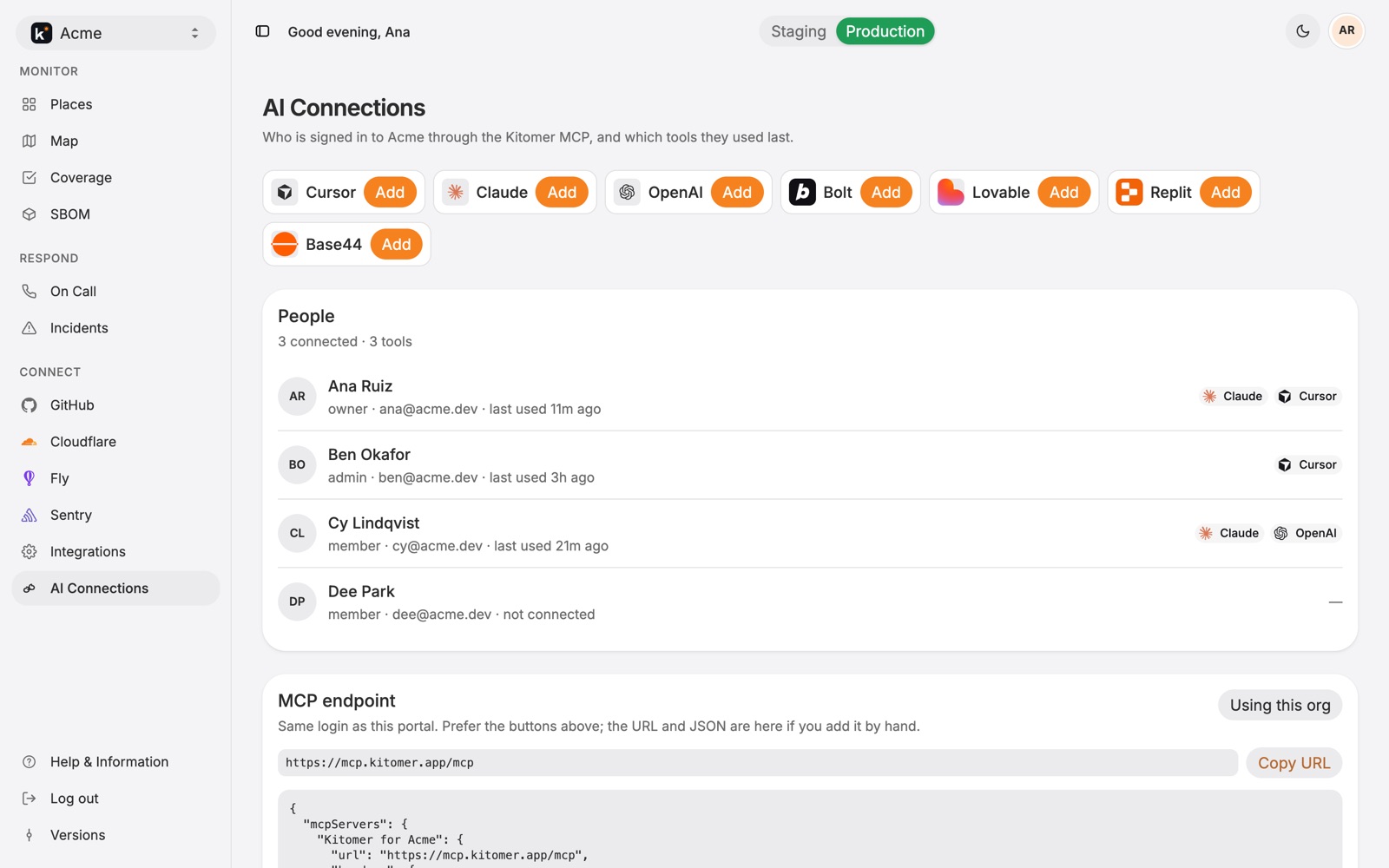
- One sign-in. The client signs in with your Kitomer account and acts as you.
- Your access level applies. An observer’s AI can read; a member’s can acknowledge and declare; an admin’s can edit places and policies.
- Kitomer does not deploy, and it does not change secrets.
Connect
Open AI Connections in the portal and press the button for your client: Cursor, Claude, OpenAI, Bolt, Lovable, Replit, or Base44. Your browser asks you to authorize Kitomer, and that’s it.
To add it by hand, the endpoint is https://mcp.kitomer.app/mcp. In Cursor’s mcp.json:
{
  "mcpServers": {
    "Kitomer": {
      "url": "https://mcp.kitomer.app/mcp"
    }
  }
}
If you belong to more than one organization, AI Connections can give you a version scoped to one, named like Kitomer for Acme, with an X-Kitomer-Org-Id header. Owners and admins see who has connected and which clients they used last.
An example
A page comes in for checkout-api. Ask your AI what happened, and it reads the incident, the place, and the logs from the same map you use:
> checkout-api just paged me. What’s going on?
get_incident          SEV1 · open 21m · paged Cy, then Ana · not acknowledged
get_node              checkout-api · Fly · acme/checkout-api · Ana Ruiz
get_place_logs        timeout acquiring connection from pool (20/20 in use)
list_similar_incidents down 19 days ago, resolved in 14m
acknowledge_incident  acknowledged · escalation stopped
add_incident_finding  evidence · fly logs
The finding appears on the incident in the portal and the iPhone app for everyone on it. When it’s over, generate_incident_write_up drafts the write-up from the timeline and findings, and seeds follow-ups from the next steps.
Every tool
Kitomer MCP 0.2.0 has 52 tools. The signed-in person’s role in the organization still applies.
| Group | Tool | What it does |
|---|---|---|
| Status | whoami | Signed-in user, default org, this AI client, and which accounts the org has connected. |
| Status | list_connections | GitHub, Fly, Cloudflare, Sentry, and which AI clients are using the MCP, plus companion MCPs to enable. |
| Status | list_organizations | Organizations the signed-in user belongs to. |
| Status | fleet_status | Heartbeat rollup across every org: up, down, and muted counts, who is on call, and down places. |
| Status | org_status | Heartbeat rollup for one org, including who is on call and a slim place list. |
| Status | current_oncall | Principal and backup on the current shift. |
| Places | list_nodes | Slim place inventory: name, environment, kind, status, last beat, latency. |
| Places | get_node | One place, including the responsible person when set. |
| Places | get_place_logs | Recent Fly stdout and stderr for a place linked to a Fly app. |
| Places | match_integrations | Match a local git remote, fly.toml, or wrangler file to Kitomer inventory. |
| Places | create_node | Create a place. Owners and admins. |
| Places | update_node | Update a place. Owners and admins. |
| Vars | search_vars | Search stored env-var snapshots by key or value. |
| Vars | get_node_vars_snapshot | Read the stored vars snapshot. |
| Vars | get_node_vars_live | Pull live /vars without saving them. |
| Vars | refresh_node_vars | Pull /vars and save the snapshot. |
| Checks | get_checks_timeline | Health-check timeline for the org’s places. |
| Checks | run_node_check | Run a health check for one place now. |
| Incidents | list_incidents | Open or recent incidents: policy pages and declared incidents. |
| Incidents | get_incident | One incident plus investigation, timeline, deliveries, MTTA and MTTR, and similar past pages. |
| Incidents | declare_incident | Declare an incident, and page on-call if you choose. SEV4 does not page. |
| Incidents | update_incident | Change summary, severity, or status. Declared incidents can be resolved here. |
| Incidents | acknowledge_incident | Acknowledge an open page so escalation stops. |
| Incidents | add_incident_finding | Append a finding: hypothesis, evidence, next step, or similar. |
| Incidents | update_incident_finding | Edit a finding. |
| Incidents | list_similar_incidents | Past pages on the same place. |
| Incidents | generate_incident_write_up | Draft a write-up from the timeline and findings, and seed follow-ups from next steps. |
| Incidents | update_incident_write_up | Replace the write-up. |
| Incidents | add_incident_followup | Add a follow-up, optionally with a GitHub issue URL. |
| Incidents | update_incident_followup | Edit a follow-up title, GitHub URL, or done flag. |
| Incidents | add_responder | Add a responder, and page them unless told not to. |
| Incidents | set_commander | Set or clear the incident commander. |
| Incidents | merge_incidents | Fold one open incident into another. The child stops paging. |
| Incidents | reopen_incident | Reopen a resolved incident, and page again if you choose. |
| Incidents | create_maintenance_window | Silence new incidents for planned work. Checks keep running. Up to seven days. |
| Incidents | create_followup_issue | Open a GitHub issue for a follow-up through the org’s GitHub App. |
| Incidents | list_alert_channels | Read alert destinations. URLs are masked. |
| Integrations | list_github_resources | Repos visible to the org’s GitHub installation. |
| Integrations | list_fly_resources | Fly apps visible to Kitomer. |
| Integrations | list_cloudflare_resources | Cloudflare resources visible to Kitomer. |
| Integrations | list_sentry_resources | Sentry projects and dashboards visible to Kitomer. |
| On-call | list_schedules | Schedules, each with timezone, ack timeout, and escalation policy. |
| On-call | get_schedule | One schedule’s week: who is on call, shifts, overrides, gaps, and patterns. |
| On-call | who_is_on_call_at | Principal and backup at a given moment, overrides included. |
| On-call | list_coverage_gaps | Windows where nobody is on call. |
| On-call | create_override | Put someone on call for a window. Members cover themselves; managers assign anyone. |
| On-call | delete_override | Remove an override. Members remove their own; managers remove any. |
| On-call | take_oncall | Make yourself on call from now for a few hours. |
| On-call | list_escalation_policies | Steps, delays, targets, severity floors, and how many times the ladder repeats. |
| On-call | update_escalation_policy | Rename a policy, change repeats, or replace its steps. Owners and admins. |
| On-call | update_alert_policy | Change schedule, ack reminder, reopen window, slow trigger, or whether it pages. Owners and admins. |
| Coach | utility_hints | Which tools exist, example questions, and which this person has not used yet. |
Companion MCPs
Kitomer knows which GitHub, Fly, Cloudflare, and Sentry accounts your organization has linked, and which repo, app, and project belong to each place. To read a vendor’s own logs or issues, your AI client also needs that vendor’s MCP. list_connections and each incident’s investigation say which ones to turn on for the session.
Try it on your own stack
Create an account, add a place or two, and connect your AI from AI Connections.